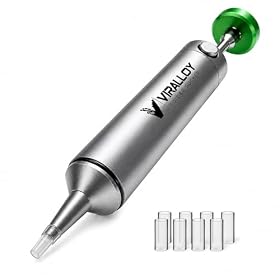
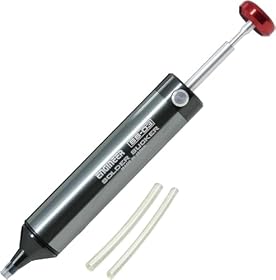
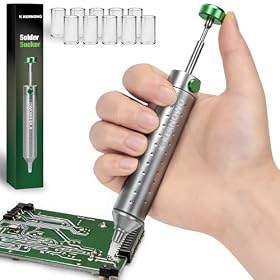
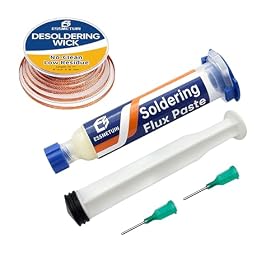
A solder sucker is usually faster for clearing larger through-hole joints, while desoldering braid offers more controlled removal from pads and tight spaces. Many electronics workbenches benefit from having both.
A solder sucker is generally the better choice for removing a large amount of solder from through-hole joints. Desoldering braid, also called solder wick, is usually better for cleaning pads, removing small amounts of solder, and working in tight areas. For regular electronics repair, the two tools complement each other rather than serving as complete substitutes.
Solder sucker versus desoldering braid at a glance
| Consideration |
Solder sucker |
Desoldering braid |
| Best for |
Large through-hole solder joints |
Pads, surface-mount work, and cleanup |
| How it works |
A spring-loaded pump pulls up molten solder |
Copper braid absorbs molten solder by capillary action |
| Speed |
Usually faster for larger joints |
Controlled but often slower for large amounts of solder |
| Precision |
Good, but can be awkward near small parts |
Very good for targeted cleanup |
| Reusable? |
Yes, when cleaned and maintained |
No; cut off and discard the used section |
| Main limitation |
Can disturb pads or scatter molten solder |
Needs heat and may not remove a large joint in one pass |
| Typical extra requirement |
A soldering iron or desoldering tip |
A soldering iron and often flux |
When to choose a solder sucker
Choose a solder sucker when you need to remove a relatively large pool of solder quickly. It is especially useful for:
- Through-hole component leads
- Connector pins
- Switches and headers
- Large solder bridges
- Joints that need to be cleared before a component is pulled out
A pump-style solder sucker is loaded, heated against the joint, and triggered so the nozzle pulls the liquid solder away. Some soldering irons also accept hollow desoldering tips that combine heat and suction, but those are different tools from a separate manual solder sucker.
Advantages of a solder sucker
- Removes more solder per operation than a short piece of braid
- Does not consume material after every joint
- Works well on larger, accessible joints
- Can clear holes in circuit boards when used carefully
Limitations of a solder sucker
The sudden suction and physical movement can stress a hot pad, particularly on older boards or boards with weak adhesive bonds. The nozzle may also be too large for closely spaced surface-mount pads. A pump can leave a thin layer of solder behind, so braid is often useful for final cleanup.
A poorly maintained pump may have a clogged nozzle, worn seal, or weak spring. Those problems reduce suction and can make the tool seem ineffective even when the technique is correct.
When to choose desoldering braid
Desoldering braid is a better fit when precision matters more than removing a large volume of solder. It is commonly used for:
- Cleaning excess solder from circuit-board pads
- Removing solder bridges between surface-mount pins
- Flattening or leveling a pad before installing a replacement part
- Cleaning small connector contacts
- Removing the last residue after a solder sucker has cleared a through-hole
To use it, place the braid over the solder, apply a clean, hot tip on top, and allow the solder to wick into the copper. Move to a fresh section when the braid becomes saturated.
Advantages of desoldering braid
- Gives good control over exactly where solder is removed
- Works well around small components and closely spaced pads
- Does not create a sudden mechanical pull on the board
- Helps leave pads relatively clean and flat
- Is simple to store and use with a soldering iron
Limitations of desoldering braid
Braid is consumable, and a narrow or short section may fill quickly on a large joint. It can also lift a pad if you hold heat on the board too long or pull the braid away before the solder has fully melted. Wide braid is not automatically better; choose a width that matches the pad or joint rather than covering a large area unnecessarily.
Which is better for through-hole components?
A solder sucker is usually the more efficient first tool for through-hole work. Heat the joint until all of the solder is liquid, position the pump nozzle close to—but not necessarily pressed hard against—the joint, and trigger the pump. If solder remains in the plated hole, repeat only after reheating the joint.
Use braid afterward if you need to clean the hole or remove a thin film of solder. Avoid levering the component out while the joint is partly solidified, since that can damage the pad or plated-through hole.
Which is better for surface-mount components?
Desoldering braid is generally more suitable for surface-mount cleanup and small solder bridges. Use a narrow braid, moderate heat, and a small amount of flux if the solder is not flowing readily.
For removing a multi-pin surface-mount component, neither a basic pump nor braid may be the ideal primary tool. Hot air, a specialized desoldering tip, or another manufacturer-approved method may be more appropriate, depending on the board and component. Avoid heating adjacent parts longer than necessary.
Which tool is safer for circuit-board pads?
Neither tool is automatically safe if the joint is not fully molten or if excessive heat is applied. Braid can be gentler because it does not yank on the joint, but pulling braid while it is stuck to solidifying solder can still lift a pad. A solder sucker can be quick, but its suction and nozzle movement may stress a weak or overheated pad.
To reduce the risk of damage:
- Secure the board so it does not move.
- Use a clean, properly sized tip.
- Add a small amount of fresh solder if the old joint will not melt easily.
- Apply heat only until the solder flows.
- Do not force a component out of a partly solid joint.
- Stop and let the area cool if the pad begins to move or discolor.
For multilayer boards, boards with delicate pads, or expensive equipment, follow the board and component manufacturer's guidance. If the work involves mains-powered equipment, disconnect it completely and allow stored energy to dissipate; seek qualified help when you are not certain the equipment is safe to service.
How to get better results from each tool
Using a solder sucker effectively
- Check that the pump is cocked and the plunger releases freely.
- Keep the nozzle clear and replace it if it is damaged or badly worn.
- Heat the entire joint, not just the surface bead.
- Trigger the pump while the solder is fully liquid.
- Empty the pump regularly so removed solder does not block the mechanism.
- Use a heat-resistant nozzle suitable for the tool if the manufacturer specifies one.
If suction is weak, inspect the nozzle, plunger seal, spring, and any removable filter or tip according to the tool's instructions. Do not lubricate or modify the pump unless the manufacturer permits it.
Using desoldering braid effectively
- Select a width close to the size of the soldered area.
- Place the braid flat on the joint.
- Put the heated tip on the braid rather than pressing the bare tip directly into the board.
- Add flux when the solder does not wick readily.
- Lift the braid and iron together once the solder has flowed.
- Cut off the saturated section before moving to the next joint.
If the braid is not absorbing solder, the joint may not be hot enough, the braid may be oxidized or contaminated, or the tip may not be transferring heat well. Adding a small amount of fresh solder and flux can improve heat transfer, but avoid prolonged heating.
Do you need both?
For occasional repairs, choose based on the jobs you expect to do:
- Mostly through-hole parts: Start with a solder sucker.
- Mostly circuit-board cleanup or surface-mount work: Start with desoldering braid.
- Mixed repair work: Keep both available.
- Delicate or valuable boards: Use braid for controlled cleanup and consider specialized desoldering equipment for complex components.
A practical combination is to use the solder sucker to remove the bulk of a large joint, then use braid to clean the pad or hole. This is often faster and more controlled than trying to make one tool handle every step.
Bottom line
Choose a solder sucker for speed and larger through-hole joints. Choose desoldering braid for precision, surface-mount cleanup, and removing the final layer of solder. If you regularly repair electronics, having both is usually more useful than choosing one as a universal replacement for the other.