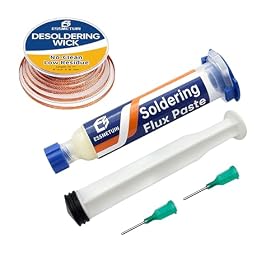
For most IC rework, choose solder wick slightly narrower than the soldered area. Fine-pitch SMD pins usually need narrow braid, while wider wick is better for large pads and through-hole joints.
Solder wick width for IC pins
Choose solder wick that is slightly narrower than the row of pins or soldered area you need to clean. For fine-pitch surface-mount ICs, narrow braid gives better control and reduces the chance of dragging across adjacent pins. Wider braid absorbs more solder from large pads and through-hole IC joints but can be awkward on small SMD pins.
Quick size guide
These are practical starting points, not rigid rules:
- About 0.8–1.5 mm: Fine-pitch SMD IC pins, small solder bridges, and precision pad cleanup
- About 1.5–2.0 mm: General-purpose SMD IC work and moderately sized pads
- About 2–3 mm: Wider SMD pads, connectors, and many through-hole IC joints
- 3 mm and wider: Large through-hole terminals, heavy solder buildup, and broad copper areas
The correct width depends on the braid, solder volume, pad size, and the amount of heat your iron can transfer. If you are unsure, a small roll in the approximately 1 mm to 2 mm range is the most useful starting point for typical electronics IC work.
Match the wick to the IC package
Fine-pitch SMD packages
For QFP, TQFP, SOIC, and other packages with closely spaced leads, use narrow wick. A narrow braid lets you work on one or a few pins at a time instead of covering several pads.
Place the braid over the solder bridge or excess solder, then place a clean, tinned iron tip on top of the braid. Lift the braid and iron together once the solder has flowed. Avoid pulling the braid sideways across the leads, since that can stress small pads or catch on pins.
For very fine-pitch packages, the smallest braid that still absorbs solder efficiently is usually easier to control. Add flux if the braid does not wet readily.
Larger SMD packages
SOIC and other larger-lead packages can often be cleaned with medium-width braid. Use enough width to contact the solder, but do not cover a large section of the board unnecessarily.
If a 1 mm braid fills quickly or requires repeated passes, move up to roughly 1.5 mm or 2 mm. If it removes solder from neighboring pads or is difficult to position, move down to a narrower size.
Through-hole IC pins
Through-hole IC sockets, headers, and DIP-style IC pins generally have more solder around each joint than fine-pitch SMD packages. Medium or wider braid is usually more efficient, especially when removing solder from a large plated-through hole.
For a plated-through hole, wick alone may not remove all the solder. Add flux and heat the joint thoroughly. If the hole remains blocked, a solder sucker or a suitable desoldering tool may be more effective than repeatedly heating the board with braid.
How to tell whether the width is wrong
The braid is too narrow when:
- It becomes saturated after only a small section
- You need several passes to clear one joint
- It does not maintain contact with a broad pad
- Removing solder takes excessive heating time
The braid is too wide when:
- It covers several fine-pitch pins at once
- You cannot position it precisely on a solder bridge
- It pulls against small leads or nearby components
- It removes solder from pads you intended to leave intact
A braid that is slightly too narrow is generally easier to control than one that is too wide for fine-pitch work. You can make multiple short passes, while an oversized braid may obstruct the joint and neighboring pins.
Technique matters as much as width
- Apply flux to the braid or joint. Flux helps the solder flow into the copper braid.
- Place the braid flat over the solder. Keep the section being used in direct contact with the joint.
- Use a clean, tinned iron tip. The tip should transfer heat effectively without excessive pressure.
- Heat briefly. Remove the iron and braid as soon as the solder flows; prolonged heating can lift pads or damage components.
- Cut off the saturated section. Fresh braid absorbs solder more effectively than a used section.
- Inspect the pins afterward. Check for remaining bridges and confirm that pads have not been pulled up.
Do not press hard on the board. If the solder will not flow, add flux, increase heat only within the component and board manufacturer's safe limits, or use a larger heat-transfer tip rather than forcing the braid into the joint.
Choosing braid length and construction
Width is the main choice for IC pins, but these details also affect results:
- Fluxed versus unfluxed braid: Fluxed braid is convenient and often wets faster. Additional flux may still be useful for oxidized solder or lead-free joints.
- Copper braid density: A more tightly woven braid may provide more solder capacity, but performance varies by product.
- Spool size: A small spool is sufficient for occasional repairs; larger spools make sense for regular rework.
- Tip compatibility: The braid should fit comfortably between nearby components and pins without forcing the iron tip into adjacent parts.
Keep the braid dry and clean. If it is oxidized or will not accept solder after adding flux, replace it rather than increasing pressure or heating time.
When to use a different desoldering method
Solder wick is well suited to removing solder bridges, leveling pads, and cleaning residual solder. It may not be the best first choice for removing a large through-hole component or clearing a fully blocked plated-through hole.
Use a solder sucker, heated desoldering tool, or professional rework equipment when the joint contains a large amount of solder. For valuable or multilayer boards, avoid repeated heating and consult the component or board manufacturer's handling guidance. Stop if a pad begins to move or discolor.
Bottom line
For fine-pitch IC pins, start with narrow solder wick around 0.8–1.5 mm. For ordinary SMD work, approximately 1.5–2 mm is a practical middle range. Use roughly 2–3 mm or wider for larger pads and many through-hole joints. Select the narrowest braid that covers the solder you need to remove, and use flux with short, controlled heating passes.