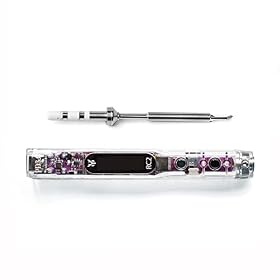
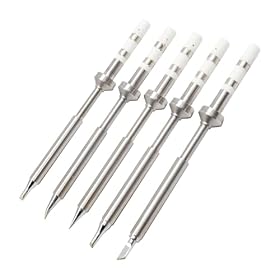
A TS-style portable iron is convenient for field work and quick repairs, while a corded station is usually the better choice for sustained bench soldering. Here’s how to choose between them.
Choose a TS-style portable iron if portability matters
A TS-style iron makes sense when you need to solder away from a permanent bench. It can fit in a small tool case and may run from a compatible USB-C power source, DC adapter, or battery bank. That makes it useful for field repairs, robotics projects, maker kits, vehicle work, and occasional cable or connector repairs.
It is also convenient for short jobs. There is no separate control box to position, and many portable irons can be stored with only a cable, power source, and a few tips.
What to check before buying a portable iron
- Power requirements: A USB-C connector does not automatically mean that every charger or power bank will provide enough power. Check the iron’s required voltage, current, and supported charging standard.
- Tip compatibility: Confirm whether the iron uses TS-style tips, cartridge tips, or another proprietary format. Replacement tips must match the specific iron.
- Temperature adjustment: Look for practical controls and a readable display or indicator if you regularly switch between leaded and lead-free solder.
- Handle temperature: Compact irons can transfer more heat to the grip during extended use, depending on the design and power level.
- Stand or storage: A portable iron still needs a safe place to rest while hot. Some kits include a stand, but not all do.
- Power-source stability: A weak charger, long cable, or unsuitable battery bank can cause slow heating or temperature drops.
A portable iron is not necessarily a low-performance tool. Its limitation is more often the power source, heat capacity, physical size, and tip system than the basic concept of a compact iron.
Choose a corded station for regular bench work
A corded station is usually the safer long-term choice for people who solder frequently. The separate control unit can provide a stable power supply, temperature adjustment, and a dedicated holder for the handpiece. This arrangement leaves the work area more organized and reduces the need to manage a cable connected directly to the iron’s handle.
A station is especially useful when you routinely solder circuit boards, connectors, wires, and larger ground planes. Larger joints can draw heat away from the tip. A station with sufficient power and thermal recovery can make those jobs more consistent, although actual performance depends on the specific station, tip, setting, and workpiece.
Advantages of a corded station
- More suitable for repeated or extended soldering sessions
- Easier to keep in a fixed, organized workspace
- Usually offers a broader range of temperature and power controls
- Separate handpiece and station can improve handling comfort
- Replacement handpieces, tips, or other parts may be available separately
- Often better suited to work that requires frequent tip changes or consistent heat recovery
A station is less convenient if you need to pack it away after every use or carry it to different locations. It also takes more desk space and requires access to an outlet.
Heat-up time and thermal recovery are different
Both types of iron may heat quickly, but heat-up time is only the time required to reach the selected temperature. Thermal recovery is how well the tool restores heat after the tip contacts a joint, connector, wire, or ground plane.
For small signal joints, either type may be adequate. For larger terminals, soldered shielding, thick wires, or large copper areas, recovery becomes more important. A portable iron may work well if it has an adequate power source and an appropriate tip, but it can be more sensitive to battery limits and voltage drops.
A corded station may provide a more consistent setup for demanding work, but do not judge performance by wattage alone. Tip size, tip condition, contact technique, solder type, and the thermal mass of the workpiece all affect results.
Tip systems affect the buying decision
Tips are not automatically interchangeable between portable irons and stations. Before choosing a tool, check:
- The exact tip family it accepts.
- Whether tips are sold in the shapes and sizes you need.
- How easily replacement tips can be found.
- Whether the tip includes an integrated heating element or is heated by a separate element in the handpiece.
- The manufacturer’s guidance for cleaning, tinning, and temperature limits.
A portable iron with inexpensive, readily available tips may be more practical than a station with a nominally better specification but difficult-to-find replacements. Conversely, a station can be the better investment when you need several tip shapes for different board and wire work.
Use a tip that is large enough to transfer heat efficiently without blocking your view of the joint. Keep the working surface tinned, avoid abrasive files unless the manufacturer specifically permits them, and replace tips when plating is damaged or solder no longer wets the surface properly.
Temperature control and solder type
Both portable irons and stations can be used with common electronics solder, but the correct temperature depends on the solder alloy, flux, joint size, and components. Lead-free solder commonly requires more heat than leaded solder, but simply increasing the temperature is not always the best solution. Excessive heat can damage pads, insulation, connectors, and temperature-sensitive components.
A useful tool should let you adjust temperature predictably and avoid accidental changes during use. Some portable irons use button controls or a small display, while stations may have a larger control panel or dedicated adjustment knob. Choose the interface you can operate easily while wearing appropriate eye protection and working under good lighting.
Which is better for beginners?
A corded station is often easier for a beginner who has a permanent work area because the holder, controls, and handpiece remain arranged in one place. It can also encourage safer habits by giving the hot iron a designated rest.
A TS-style iron may be easier for a beginner on a tight budget or with limited storage, but the user must supply a safe stand and a suitable power source. A beginner should not treat a portable iron like a pen that can be set down anywhere. The tip remains hot after power is removed, and the unit should cool on a nonflammable stand or other manufacturer-approved surface.
Whichever type you choose, prioritize:
- A reliable temperature-control system
- A stable stand
- Replaceable tips
- A handle that stays comfortable during normal use
- A grounded or otherwise properly designed power system
- Clear manufacturer instructions
Which one is better for different jobs?
Small circuit-board repairs
Either type can work well for small board repairs. A portable iron is convenient if the job is occasional or performed away from a bench. A corded station is more convenient when you need several tip shapes, frequent adjustments, or a stable stand beside the board.
Wires and connectors
For thin wires and small connectors, either tool may be suitable. Larger wire gauges and high-mass connectors place greater demands on thermal recovery. Use an appropriately sized tip and avoid holding heat on a pad longer than necessary.
Lead-free soldering
Lead-free solder can be more demanding because it often needs a higher working temperature and good heat transfer. A corded station may be preferable for frequent lead-free work, but a portable iron can still be suitable when its power source and tip are adequate for the joint.
Field repairs
The portable iron has the clear advantage when you need to work in multiple locations. Before relying on it, verify that your charger, battery bank, or DC supply can meet the tool’s requirements. Carry spare tips, solder, flux, a stand, and a safe way to power the iron.
Daily production or repair work
For daily use, a corded station is generally the more practical format. It is easier to leave set up, use for longer sessions, and maintain with replacement parts. For professional or safety-critical work, select equipment according to the manufacturer’s ratings and workplace requirements.
Common problems and what to check
The portable iron heats slowly or shuts down
Check the power source first. Confirm that the charger or battery bank supports the required power, then inspect the cable and connector for damage. A low-power adapter can make the iron appear defective when it is simply underpowered.
If the power source is correct, inspect the tip. A loose, damaged, oxidized, or incompatible tip can prevent normal heating. Let the iron cool, remove and reinstall the tip according to the instructions, and replace it if needed.
The station reaches temperature but struggles on joints
Check that the tip is clean, tinned, and large enough for the joint. Confirm the temperature setting and solder type, but do not keep raising the temperature indefinitely. If a clean, correctly fitted tip still loses heat quickly, the joint may have too much thermal mass for the selected tip or tool.
Solder will not wet the tip or joint
Oxidation, contamination, insufficient flux, or an unsuitable temperature can prevent wetting. Clean and tin the tip, apply appropriate flux where allowed, and verify that the workpiece is clean. Do not scrape plated tips with aggressive abrasives unless the manufacturer specifically allows it.
The handle or cable becomes unusually hot
Stop using the tool if the handle, cable, connector, or power supply becomes excessively hot, smells burnt, shows discoloration, or behaves intermittently. Disconnect it and follow the manufacturer’s service guidance. Do not open mains-powered equipment unless you are qualified to do so and the instructions explicitly permit the work.
Bottom line
Choose a TS-style portable iron for mobility, compact storage, and short repairs where a suitable power source is available. Choose a corded station for frequent bench work, longer sessions, broader tip selection, and more consistent control.
If you are unsure, base the decision on your workspace and job pattern rather than advertised maximum temperature. A stable stand, compatible replacement tips, adequate power, predictable temperature control, and safe handling will matter more in everyday soldering than portability or peak specifications alone.