A reviewer showing perfect joints on a brand-new board demonstrates basic soldering technique, not necessarily how a station performs during repairs. To judge a soldering station, look for clear settings and process details, work on varied components and boards, and evidence that the tool can complete realistic tasks without hiding mistakes or interruptions.
Reviews · Tue Sep 22
Reviewers Showing Perfect Joints on Brand-New Boards Only
Flawless joints on a clean new circuit board make a good demonstration, but they do not prove a soldering station will handle repairs well. Look for realistic jobs, visible process details, and repeatable results.
What a perfect new-board demo can tell you {#new-board-demo}
A clean, untouched board is a useful starting point: it lets you see whether the reviewer can place and heat components neatly. But it is a forgiving test. Pads are intact, the board is clean, and the work may involve components that are easy to reach.
The demo alone says little about how the station handles a repair with a large ground plane, an oxidized connection, a crowded board, or a component that needs careful removal. It also cannot establish that the station’s displayed temperature matches the tip temperature or that the iron recovers consistently under every workload.
Compare soldering stations for electronics repair
 Soldering Station, 100W Digital Display Soldering Iron Station Kit with 2 Helping Hands, 356°F -…Crtsweker
$29.99 as of
View on Amazon WEP 882D Soldering Iron Station 2-IN-1 SMD Hot Air Rework Station with 2 Spools of…WEP
$59.99 as of
View on Amazon WEP 926LED V3 Soldering Station 130W MAX Soldering Iron Kit with Solder Wire, 5 Soldering…WEP
$27.99 as of
View on Amazon
Product prices and availability are accurate as of the date/time indicated and are subject to change. Any price and availability information displayed on Amazon.com at the time of purchase will apply to the purchase of this product.
Look for evidence beyond the finished joint {#review-evidence}
Useful reviews show enough of the process to connect the result to the tool:
- The station and settings: The model, selected temperature, and tip type should be visible or clearly stated. A temperature setting is useful context, not proof of exact tip temperature.
- The materials: The reviewer should identify the solder and, where relevant, flux. Different solder and flux choices can affect how easily a joint forms, so results are hard to compare when these are left out.
- A continuous or repeatable demonstration: Watch for the iron heating, solder flowing, and the work being inspected. Repeated examples are more informative than a single close-up of a finished joint.
- Different kinds of work: Through-hole joints, small surface-mount connections, desoldering, and repair work place different demands on technique and equipment. A reviewer need not cover everything, but the demo should match the work you plan to do.
- Practical handling: Look for comments or footage about reaching the joint, changing tips, keeping the tip clean and tinned, and working without awkward cable or handpiece movement.
A useful close-up shows the joint and nearby pads clearly. For through-hole work, check that solder has flowed around the lead and pad without obvious bridging. For surface-mount work, look for controlled solder placement and no visible bridges between adjacent connections. Appearance is not a complete quality test: solder alloy and flux can affect shine, so do not treat a bright finish as the only sign of a good joint.
Choose solder for electronics work
 MAIYUM 63-37 Rosin Core Solder Wire 0.8mm 50g Tin Lead Electrical SolderingMAIYUM
$8.99 as of
View on Amazon TOWOT 63-37 High Purity Tin Lead Rosin Core Solder Wire for Electrical Soldering, Content 1.8%…TOWOT
$6.47 as of
View on Amazon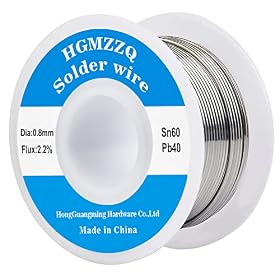 HGMZZQ 60/40 Tin Lead Solder Wire with Rosin core for Electrical Soldering 0.031 inch(0.8mm-50g)HGMZZQ
$9.99 as of
View on Amazon
Product prices and availability are accurate as of the date/time indicated and are subject to change. Any price and availability information displayed on Amazon.com at the time of purchase will apply to the purchase of this product.
Treat repair footage as a stronger stress test {#repair-footage}
For electronics repair, prioritize reviews that show a realistic task on an older or previously assembled board. Useful examples include removing a component, replacing a connector, or soldering a joint attached to a larger copper area. These tasks reveal more about access, heat transfer, and the reviewer’s process than a row of identical joints on a fresh practice board.
Pay attention to whether the reviewer explains what made the job difficult and how they responded. A careful operator may adjust the tip, add suitable flux, or allow the joint to heat properly rather than simply turning the temperature up. A video that shows repeated attempts, unexplained cuts, or a finished result without the working steps is weaker evidence—not automatic proof that the station is poor, but a reason to seek another source.
Separate station performance from soldering skill {#station-versus-skill}
A good-looking joint depends on the station, tip condition and shape, solder, flux, board design, and operator technique. A skilled reviewer can make clean joints with many tools, while poor setup or technique can make a capable station look ineffective.
Give more weight to comparisons where the reviewer uses similar components and materials, explains any changes, and shows more than the final result. Be cautious about conclusions based only on a temperature number, a short clip, or a claim that one station is faster without comparable working conditions.
A practical review checklist {#review-checklist}
Before relying on a soldering-station review, ask:
- Does it show the station and handpiece clearly enough to identify what is being reviewed?
- Are the tip, temperature setting, solder, and flux disclosed when they affect the demonstration?
- Does the reviewer show the process and inspect the finished work, rather than only presenting polished close-ups?
- Is there work resembling your own—especially repairs, desoldering, or connections with more heat demand?
- Do other independent reviews support the same strengths and limitations?
If a review only shows perfect joints on clean new boards, treat it as an introductory technique demo. Use it to judge visibility and basic handling, but look elsewhere for evidence about repair performance, controls, durability, and suitability for your projects.
FAQ
Are perfect solder joints on a new board a sign of a good soldering station?
They show that the reviewer can produce neat joints in those conditions, but do not prove how the station performs on repairs, larger copper areas, or other demanding tasks.
Should solder joints always look shiny?
No. Appearance varies with the solder alloy and process. Judge whether the solder flowed properly and whether there are visible defects such as bridges, rather than relying on shine alone.
What kind of video is most useful when comparing soldering stations?
Look for a clear, repeatable demonstration with the station settings, tip, solder, and flux identified, plus work that resembles the jobs you plan to do.