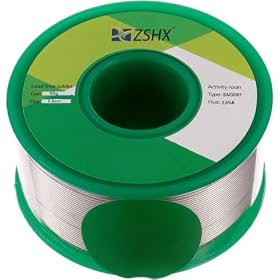
For most electronics hand soldering, start around 315–350°C (600–660°F) with leaded solder or 350–380°C (660–715°F) with lead-free solder. Adjust for the joint and tip rather than relying on one setting for every job.
For most electronics work, start your iron at 315–350°C (600–660°F) for common leaded solder or 350–380°C (660–715°F) for common lead-free solder. These are practical iron setpoints, not the melting points of the solder: the joint needs to get hot enough to melt the solder, and the iron loses heat when it touches the work.
Use the lowest setting that makes a clean joint promptly. If solder will not flow after a few seconds, improve heat transfer or check the setup before simply turning the temperature much higher.
These ranges are starting points, not universal rules. Check the solder and equipment manufacturers’ guidance, especially for unusual alloys or temperature-sensitive work. Leaded solder melts at a lower temperature than many common lead-free alloys, but the iron must be set higher than the solder’s melting point to transfer heat into the joint.
Temperature-controlled station for electronics soldering
Product prices and availability are accurate as of the date/time indicated and are subject to change. Any price and availability information displayed on Amazon.com at the time of purchase will apply to the purchase of this product.
Adjust for the joint, not just the solder
A small signal-wire connection may solder well near the lower end of the range. A large connector, ground plane, or heavy wire can draw heat away quickly and may need a higher setting or a larger tip. Try these adjustments in order:
Use a tip that fits the joint. A tip with enough contact area transfers heat more effectively than a very fine tip. Choose a shape that can touch both the pad and lead where possible.
Make sure the tip is clean and tinned. A thin layer of solder on a clean tip improves heat transfer. Wipe and re-tin it as needed, following the iron manufacturer’s instructions.
Use suitable flux. Flux helps solder wet clean metal; it does not compensate for a poorly heated joint or contaminated surfaces.
Increase the setting modestly if needed. If the joint still will not flow promptly, raise the temperature in small steps and reassess. Avoid leaving the iron on the joint for a long time.
A temperature-controlled station with good heat recovery can maintain its setpoint better when soldering larger joints. That can be more useful than choosing an unnecessarily high temperature on a less capable iron.
Product prices and availability are accurate as of the date/time indicated and are subject to change. Any price and availability information displayed on Amazon.com at the time of purchase will apply to the purchase of this product.
Why the iron setting is higher than solder’s melting point
The displayed temperature is the iron’s target tip temperature, not the temperature of the entire joint. Heat must travel from the tip into the pad, component lead, and solder. Contact quality, tip size, copper area, and the iron’s ability to recover heat all affect how quickly the joint warms.
Common leaded Sn63/Pb37 solder melts at about 183°C (361°F). Common lead-free SAC solder melts over a higher range, roughly 217–220°C (423–428°F). Those figures describe the solder alloy; they are not recommended iron settings.
Product prices and availability are accurate as of the date/time indicated and are subject to change. Any price and availability information displayed on Amazon.com at the time of purchase will apply to the purchase of this product.
Avoid excessive heat and long dwell time
Very high settings can oxidize tips faster and increase the risk of damaging pads, insulation, or heat-sensitive components. Do not try to solve every slow joint by raising the iron to its maximum. First check tip contact, cleanliness, flux, and whether the joint has a large copper area.
Keep contact brief and controlled. If a component has a stated soldering temperature or time limit, follow its datasheet and the soldering equipment instructions. For delicate parts, use the manufacturer’s recommended process and consider a heat sink only if appropriate for that component.
Use ventilation or local fume extraction, and wash your hands after handling solder—especially leaded solder. Keep solder and hot tools away from food, and follow applicable workplace and disposal guidance.
Troubleshooting: solder will not melt or flow
Check the tip first: clean it, apply fresh solder to tin it, and confirm it is heating normally.
Check the contact: use a tip with enough surface area and touch both parts of the joint if possible.
Check the materials: solder adheres poorly to dirty, oxidized, or coated surfaces. Clean the joint as appropriate and apply electronics flux.
Check the setting and recovery: confirm the station is in the correct temperature mode and give it time to reach temperature. Increase the setpoint modestly if the setup is sound but the joint still loses heat.
Stop if the pad or component is overheating: let it cool and reassess rather than holding the iron on longer.
If the station cannot maintain heat even with a suitable tip and a reasonable setting, consult its manual. A damaged heater, sensor, cord, or connector may need qualified repair or replacement; do not open or repair mains-powered equipment unless you are qualified to do so.
FAQ
What temperature should I use for lead-free electronics solder?
A practical starting range is 350–380°C (660–715°F). Adjust based on the joint, tip, and equipment, and follow the solder and component manufacturers’ guidance.
What temperature should I use for leaded solder?
Start around 315–350°C (600–660°F) for common leaded electronics solder. The right setting depends on the joint’s size and how well the tip transfers heat.
Is 400°C too hot for electronics soldering?
It is higher than a typical starting setting for many electronics joints and can speed tip wear or increase damage risk. Some demanding joints may require adjustments, but first check tip size, contact, cleanliness, flux, and station heat recovery.
Does soldering temperature mean the solder’s melting point?
No. The melting point is a property of the solder alloy. The iron setpoint is higher because heat must transfer from the tip into the joint.