Plumbing solder should generally stay off circuit boards and electronic connections. Its flux may be corrosive, its alloy may not suit electronics work, and the residue can damage connections over time. Use solder and flux labeled for electronics instead; a shiny joint is not proof that the materials are compatible.
Consumables · Mon Sep 21
Why Plumbing Solder Should Not Be Used on Electronics
Plumbing solder may melt onto a circuit board, but its flux, alloy, and intended use can make it a poor choice for electronics. Use solder and flux labeled for electronic work.
Why plumbing solder can damage electronics
“Solder” describes a joining material, not one universal product. Plumbing and electronics solders can differ in both their metal alloys and their flux.
- Flux residue may be corrosive. Plumbing flux is formulated to clean metal pipe surfaces and may contain active chemicals that should not remain on a circuit board. Residue can attack metal, cause leakage between conductive points, or contribute to intermittent failures. Not every plumbing solder contains the same flux, so check the label rather than assuming.
- The alloy may be unsuitable. Plumbing solder is selected for pipe joints, not necessarily for small electronic pads and components. Its melting behavior and working characteristics may make it harder to create a controlled joint without overheating nearby parts.
- The solder may be the wrong form. Plumbing products can be solid wire or paired with separate flux; some solder wire has a flux core. A product that appears to be plain solder is not necessarily electronics-grade.
Even if a plumbing solder is lead-free, that alone does not make it suitable for electronics. Lead-free describes the alloy’s lead content, not whether its flux and intended use are appropriate for a circuit board.
Electronics solder wire
 MAIYUM 63-37 Rosin Core Solder Wire 0.8mm 50g Tin Lead Electrical SolderingMAIYUM
$8.99 as of
View on Amazon TOWOT 63-37 High Purity Tin Lead Rosin Core Solder Wire for Electrical Soldering, Content 1.8%…TOWOT
$6.47 as of
View on Amazon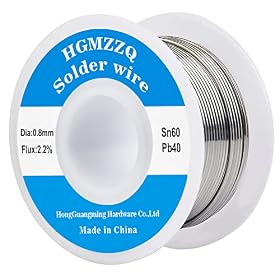 HGMZZQ 60/40 Tin Lead Solder Wire with Rosin core for Electrical Soldering 0.031 inch(0.8mm-50g)HGMZZQ
$9.99 as of
View on Amazon
Product prices and availability are accurate as of the date/time indicated and are subject to change. Any price and availability information displayed on Amazon.com at the time of purchase will apply to the purchase of this product.
What to use for electronics instead
Choose solder explicitly labeled for electronics or electrical work, and follow the device or component manufacturer’s requirements when available. The package should identify the alloy and whether the solder has a flux core. For delicate work, a thinner wire is often easier to control than thick plumbing solder.
Use electronics-grade flux if extra flux is needed. Flux labeled no-clean still needs to be used according to its instructions; “no-clean” does not mean every residue is harmless in every application. Rosin or other electronics fluxes also vary, so check whether the manufacturer recommends cleaning and what cleaner is compatible.
Do not select solder by diameter alone. Alloy, flux type, the parts being joined, and the equipment’s temperature control all matter. A soldering iron or station should be suitable for the joint and used at the temperature recommended for the materials and components.
Electronics flux
 SRA Solder 135 Rosin Paste Soldering Flux For Electronics, No Clean Flux Made for Lead…SRA Soldering Products
$8.49 as of
View on Amazon Liquid Solder Flux Dropper (30 ml/1 Oz.) I RMA Liquid Solder Flux I Soldering Flux…QUIMTECH
$6.99 as of
View on Amazon Liquid Soldering Flux for Electronics, No Clean Rosin Flux, Dropper Squeeze Bottle, 30 mL/1.05 Ozwyunway
$4.99 as of
View on Amazon
Product prices and availability are accurate as of the date/time indicated and are subject to change. Any price and availability information displayed on Amazon.com at the time of purchase will apply to the purchase of this product.
If plumbing solder was already used
- Disconnect power. Unplug the equipment and remove batteries where practical. Do not work on energized electronics.
- Check the labels. Identify the solder and any separate flux. If the flux is intended for plumbing or its chemistry is unclear, treat the residue as unsuitable for a circuit board.
- Remove the solder and residue carefully. For a small, accessible joint, solder wick or a solder sucker can help remove solder. Use electronics-grade flux as needed, then clean only with a method and solvent compatible with the board and components. Follow the flux and device manufacturers’ instructions; do not flood connectors, switches, or components that should not get wet.
- Inspect before powering up. Look for residue, damaged pads, lifted traces, bridges between conductors, or corrosion. If contamination is under a component or you cannot clean and inspect the area reliably, have a qualified repair technician assess it.
Avoid scraping aggressively or applying more heat than needed: circuit-board pads and small components can be damaged easily. If a simple joint cannot be safely reworked, or the board shows corrosion or lifted pads, professional repair—or replacement of the affected assembly—may be more reasonable than continued DIY work.
Solder removal supplies
 Lesnow solder wick braid 10ft Length Desoldering Wick Braid Remover Tool Solder Sucker 1 piece…Lesnow
$6.99 as of
View on Amazon Lesnow Solder Flux Paste And Solder Wick Braid, No Clean Soldering Flux(10cc) Soldering Remover Tool,…Lesnow
$8.99 as of
View on Amazon 3PCS Solder Wick Braid with Flux, Upgraded Desoldering Wick, 3 SizesRkiiqii
$4.15 as of
View on Amazon
Product prices and availability are accurate as of the date/time indicated and are subject to change. Any price and availability information displayed on Amazon.com at the time of purchase will apply to the purchase of this product.
FAQ
Can plumbing solder work on electronics if it is lead-free?
Not necessarily. Lead-free only describes lead content. Check that the solder and its flux are intended for electronics; plumbing flux may leave residues that can damage a circuit board.
Is all plumbing solder corrosive?
No. Products vary, and some are solid solder used with a separate flux. Check both the solder and flux labels. If either is intended for plumbing or the chemistry is unclear, do not use it on electronics.
Can I clean plumbing flux off a circuit board?
Sometimes, if the residue is accessible and the board and components can safely be cleaned using a compatible method. Follow the product and device instructions. Seek professional help if residue is under components or corrosion is visible.
What solder should I use for electronics?
Use solder labeled for electronics or electrical work, with an alloy and flux appropriate for the parts being joined. Follow the manufacturer’s recommendations, especially for sensitive components.