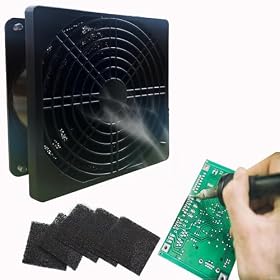
If flux smoke is filling a small room, stop soldering, ventilate the space, and move the extraction nozzle close to the solder joint. Then check the filter, airflow path, seals, and setup before assuming the extractor motor has failed.
If flux smoke is filling a small room, stop soldering and ventilate the space first. Open a window or door if practical, leave the room if the air is irritating, and avoid relying on a small fan that simply blows fumes around. Once the air has cleared, place a fume extractor close to the solder joint—usually just a few inches away—so smoke is captured before it spreads.
Why flux smoke spreads so quickly
Flux smoke is produced when flux residues heat during soldering. In a small room, even a short soldering session can make the haze noticeable, especially when:
- The extractor is too far from the work
- The airflow is aimed away from the smoke plume
- A bench fan disperses fumes instead of capturing them
- The extractor filter is clogged or saturated
- The room has little fresh-air exchange
- You are applying more flux than necessary
- The soldering temperature is higher than the flux requires
A fume extractor helps, but a small desktop unit is not a substitute for adequate room ventilation. Do not treat the absence of visible smoke as proof that all airborne contaminants have been removed.
Fix the problem in this order
1. Check the filter
Unplug the extractor and inspect its filter according to the manufacturer’s instructions. A visibly dirty, saturated, damaged, or incorrectly installed filter can greatly reduce airflow.
Check that:
- The filter is the correct type and size for the extractor
- Protective packaging has been removed from a replacement filter
- The filter is seated in the correct direction
- No dust, solder debris, or flux residue is blocking the intake
- The filter has not exceeded its recommended service interval
Do not wash or reuse a filter unless the manufacturer specifically says it is washable. Replace carbon or combined filters when they are exhausted; cleaning the outside does not restore their ability to adsorb vapors.
2. Inspect the hose, intake, and airflow path
For a hose-based extractor, disconnect power and check the entire hose for kinks, crushed sections, loose joints, or obstructions. Look through the intake and confirm that the grille is not blocked by scraps, tape, solder, or accumulated dust.
If the unit has a removable prefilter, clean or replace it as directed. A clogged prefilter can make the main filter appear to be the problem by restricting airflow before air reaches it.
Never push sharp objects deep into a hose or fan housing to clear a blockage. If an obstruction cannot be removed safely, follow the service instructions or have the unit inspected.
3. Look for leaks around seals and connections
Air can bypass the filter or escape before reaching the intake if a hose connection, filter cover, duct joint, or collection area is not seated correctly. With the extractor running, check for loose connections and unusual air movement around the housing.
Turn the unit off before reseating parts. Do not seal a manufacturer-designed ventilation opening, and do not modify the housing with tape or adhesive if doing so could restrict cooling or interfere with servicing.
Position the intake between your face and the solder joint, without blocking your view or putting the intake so close that it interferes with the iron. The goal is to capture the rising plume at its source.
A rear-of-bench unit may work better with its intake close to the joint than with the fan placed several feet away. If using a flexible arm or hose, keep the route short and avoid tight bends.
Do not aim a separate fan directly across the soldering area. Cross-drafts can carry smoke past your face or spread it throughout the room. If you need general ventilation, use airflow that removes contaminated air from the work area rather than recirculating it.
5. Check the room and work setup
Close nearby doors to prevent fumes from spreading through the building, but provide a safe route for stale air to leave. If possible, solder near an open window with an exhaust fan venting outdoors. Do not vent fumes into another occupied room.
Use the minimum effective amount of flux and avoid repeatedly reheating heavily fluxed surfaces. Keep the iron at the lowest temperature that produces a reliable joint, following the solder and flux manufacturer’s guidance. Excessive heat can increase visible smoke and degrade flux more quickly.
If you solder frequently in a small room, a source-capture extractor with a suitable filter is generally more useful than a fan placed across the bench. A unit with a flexible capture arm can keep the intake near the joint while leaving both hands available.
6. Check for a full collection area or exhausted filter
Some extractors collect particles in a prefilter, dust compartment, or replaceable filter. If that area is full, airflow may fall even though the motor still sounds normal. Empty or replace it only as the instructions permit.
A carbon filter may look clean while being saturated. Odor returning, reduced effectiveness, or the manufacturer’s replacement interval can be a reason to install a new filter. Carbon filters do not last indefinitely, and they are not interchangeable with particle filters unless the unit is designed for both.
7. Consider the motor or electrical system last
If the filter, airflow path, seals, and setup are correct but suction remains weak, the fan or motor may be worn or obstructed. Unusual noise, intermittent operation, overheating, a burning smell, damaged wiring, or a tripping breaker are reasons to switch the extractor off and unplug it.
Do not open or repair a mains-powered extractor unless you are qualified and the manufacturer permits that service. Replace the unit or arrange qualified service when the motor has failed, replacement parts are unavailable, or repair would cost close to a suitable replacement extractor.
Reduce the amount of smoke at the joint
Fume extraction should be paired with better soldering technique:
- Use solder and flux intended for the task rather than adding excess liquid flux
- Apply flux sparingly and avoid flooding the board
- Keep the iron tip clean and properly tinned
- Use a temperature appropriate for the solder and component, as specified by the manufacturer
- Remove the iron from the joint promptly after the solder flows
- Keep your face out of the rising plume even when extraction is running
- Wash your hands after soldering and before eating or drinking
Rosin-based flux fumes can irritate the eyes, nose, throat, and lungs. “Low smoke” or “no-clean” flux does not mean risk-free, and visible smoke is only one part of what may be released during heating. Check the product’s safety data sheet for handling and ventilation guidance.
When a replacement is reasonable
Replace the filter when it is saturated, damaged, or no longer supported by the extractor manufacturer. A new extractor may be the better choice when the current unit cannot capture fumes at the work position, has persistently weak airflow after basic checks, lacks available filters, or is making unsafe electrical or motor noises.
For frequent soldering in a small room, choose an extractor based on capture position, replacement-filter availability, filter type, noise, and the manufacturer’s stated application—not just the fan’s advertised airflow. If the work involves unusually hazardous materials, heavy production soldering, or persistent room contamination, consult a qualified industrial-hygiene or ventilation professional rather than relying on a small desktop device alone.