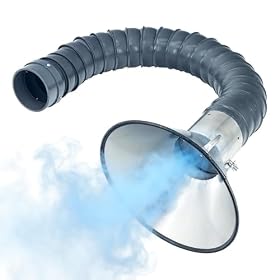
A kitchen-table soldering setup needs a compact extractor that captures smoke near the joint without taking over the workspace. Here is how to choose one and use it safely.
A compact soldering fume extractor can make a kitchen-table bench more comfortable, but it works best when the intake is close to the smoke source. Look for a small source-capture unit with replaceable filters, manageable noise, and a footprint that fits your available space. Keep the room ventilated too: a benchtop extractor is not a substitute for general ventilation, especially when using flux that produces noticeable fumes.
What to look for in a kitchen-table extractor
Source capture matters most
The extractor should pull smoke away from the solder joint before it reaches your face. A movable arm, adjustable intake, or angled front grille is more useful than a powerful fan placed several feet away.
Position the intake close enough to capture the rising smoke, but not so close that it interferes with the iron, your hands, or the workpiece. If you routinely move around the board, an adjustable arm can be easier to position than a fixed desktop unit.
Compact size and stable placement
Measure the area beside or behind your work mat before buying. Check the unit’s overall width, depth, height, and the space needed for an adjustable arm. A narrow extractor may fit better on a kitchen table, while a larger unit may provide a broader capture area but leave less room for components and tools.
A stable base is important. The fan should not shift when you reposition the intake or bump the table. Rubber feet, a weighted base, or a clamp-style mounting option can help, depending on your setup.
Filter design
Most small soldering extractors use a combination of particulate filtration and activated carbon or another odor-adsorbing material. These stages serve different purposes:
Activated carbon can reduce some odors and certain airborne compounds.
A replaceable filter is essential for long-term use because filters become less effective as they load up.
Do not assume that a carbon filter removes every chemical exposure from flux or soldering. Filter performance depends on the filter material, amount of carbon, airflow, distance from the joint, and condition of the filter. Confirm that replacement filters are available before choosing a unit.
Noise and controls
Noise matters more at a kitchen table than in a workshop. A fan that is unpleasant to run may not be used consistently. If the specification lists sound level, compare units using the same measurement conditions; otherwise, treat broad noise claims cautiously.
Variable-speed control is useful when you need quieter operation for light work and more airflow for larger joints or heavier flux use. A simple on/off unit can still work well if the intake is positioned correctly.
Power and storage
Check the power connection, cord length, switch location, and whether the unit can be stored without removing the arm. For a temporary kitchen-table station, easy setup and storage may matter more than maximum airflow. Keep the power cord away from the hot iron and arrange it so the iron cannot pull the extractor or soldering mat off the table.
Desktop extractor or external ventilation?
Compact desktop extractor
A small desktop extractor is usually the simplest choice for occasional electronics work. It needs no permanent installation and can be placed beside the project when needed. Its limitations are a smaller capture area, filter replacement costs, and the possibility that smoke will escape if the intake is poorly positioned.
Articulated-arm extractor
An extractor with a flexible or articulated arm can hold the intake closer to the joint. This is helpful when soldering small boards or working in a fixed position. Make sure the arm stays where you place it and does not sag toward the hot iron.
Exhausting outdoors
A ducted system that exhausts outdoors can remove contaminants from the room rather than recirculating filtered air. It is less convenient for a temporary kitchen-table setup and may require suitable window access, sealing, and safe electrical routing. Do not improvise a duct arrangement that blocks ventilation, creates a trip hazard, or exhausts into another occupied area.
Air purifier
A room air purifier can improve general air circulation, but it is not the same as source capture. It may move air around without removing smoke at the solder joint. If you already have one, it can be supplementary, not a replacement for an extractor positioned near the work.
Product prices and availability are accurate as of the date/time indicated and are subject to change. Any price and availability information displayed on Amazon.com at the time of purchase will apply to the purchase of this product.
How to use the extractor effectively
Set up on a heat-resistant work surface. Use a proper soldering mat and keep the iron in a stable stand.
Place the extractor beside or slightly behind the joint. Avoid positioning it directly between your eyes and the work if that blocks your view.
Keep the intake near the rising smoke. Airflow falls off with distance, so a small unit cannot compensate indefinitely for poor placement.
Turn it on before soldering. Leave it running briefly afterward if smoke or odor remains.
Keep the room ventilated. Open a window or use suitable room ventilation when practical, while avoiding drafts that blow smoke toward your face.
Wash your hands after soldering. Do not eat or prepare food at the same work surface, and clean the table after the project.
If you solder frequently, use leaded solder, or work with strong flux, take additional precautions and follow the solder, flux, extractor, and workplace-safety instructions. People with respiratory sensitivities may need stronger ventilation or a different workspace.
Product prices and availability are accurate as of the date/time indicated and are subject to change. Any price and availability information displayed on Amazon.com at the time of purchase will apply to the purchase of this product.
When the extractor is not doing enough
If smoke reaches your face, check the setup before assuming the fan is defective:
Move the intake closer to the joint.
Check whether the filter is clogged, saturated, or installed backward.
Confirm that the fan inlet and outlet are not blocked by a wall, box, or loose filter cover.
Make sure the filter is the correct replacement for the unit.
Check whether a draft from a fan, HVAC vent, or open window is carrying smoke away from the intake.
Increase the fan speed if the unit has adjustable control.
Reduce excessive flux use where the soldering process allows it.
A dirty or saturated filter is often the first part to replace. If a new, correctly installed filter does not restore useful airflow and the fan makes unusual noises, intermittently stops, or has a damaged cord, discontinue use. Electrical repairs should follow the manufacturer’s instructions or be handled by a qualified professional. For a low-cost unit with unavailable filters or a failing motor, replacing the extractor is usually more practical than repairing it.
Product prices and availability are accurate as of the date/time indicated and are subject to change. Any price and availability information displayed on Amazon.com at the time of purchase will apply to the purchase of this product.
Is a small extractor enough for your work?
A compact unit is reasonable when you solder occasionally, work on small circuit boards, and can keep the intake close to the joint. Choose a larger or more capable source-capture system if you solder for long periods, work on larger assemblies, use substantial amounts of flux, or cannot position the intake near the work.
For a kitchen-table bench, the best balance is usually a stable, compact extractor with a movable intake, replaceable particulate and odor-control filters, accessible controls, and noise that you can tolerate during a complete project. Treat it as one part of a safe setup rather than the only control for soldering fumes.
FAQ
Do I need a fume extractor for occasional soldering?
It is a sensible precaution, especially when soldering indoors. Even with an extractor, position the intake close to the joint, keep the room ventilated, avoid breathing directly over the work, and follow the solder and flux manufacturer’s safety guidance.
Is a kitchen-table fume extractor the same as an air purifier?
No. A fume extractor is intended to capture smoke near the soldering joint. An air purifier treats room air and may not capture smoke before it reaches you. An air purifier can supplement source capture but should not replace it.
How often should I replace the extractor filter?
Replace it according to the manufacturer’s schedule or sooner if airflow drops, odors return, the filter looks heavily loaded, or the extractor no longer captures smoke effectively. Filter life depends on soldering frequency, flux use, airflow, and filter size.
Where should I position a soldering fume extractor?
Place the intake near and slightly behind the soldering joint so it captures rising smoke without blocking your view or interfering with the iron. Avoid drafts that push smoke away from the intake.