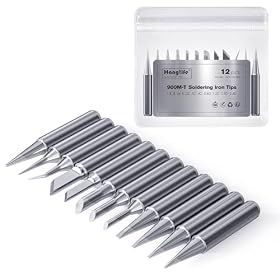
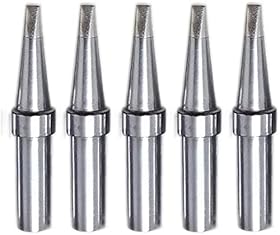
The right replacement soldering tip must match your station’s tip family and heating design. Use the compatibility checks below before choosing a size or shape.
Replacement soldering tips are not universally interchangeable. Before buying, identify the exact station or iron, confirm the tip family it accepts, and then choose the tip shape and size for your work. A tip that looks similar may fit poorly, heat incorrectly, or fail to transfer heat efficiently.
Start with the station and iron model
Look for the model information on the station housing, iron handle, power cord label, or original packaging. The manufacturer’s manual or replacement-parts list is the most reliable way to identify compatible tips.
If the station has a detachable iron, identify both:
The station model
The handpiece or iron-handle model
The tip series or cartridge family listed for that handpiece
Avoid choosing a tip based only on a similar-looking product photo. Soldering tips can share the same general shape while using different internal heater arrangements or dimensions.
Check the tip style
Replacement tips generally fall into two broad categories:
Separate tips for a heated shaft
With this design, the heater is part of the iron and the removable tip slides over or around the heated shaft. These tips are often available in multiple diameters and shapes.
Integrated heater cartridges
With a cartridge-style design, the heating element and temperature sensor are built into the replaceable tip assembly. These tips are usually more expensive, but they can heat quickly and provide direct temperature sensing near the joint.
A separate shaft tip usually cannot replace a cartridge, and cartridge families are not automatically interchangeable between stations. Confirm the design before ordering.
Product prices and availability are accurate as of the date/time indicated and are subject to change. Any price and availability information displayed on Amazon.com at the time of purchase will apply to the purchase of this product.
Match the tip family before the tip shape
The tip family is the primary compatibility requirement. Check the manufacturer’s documentation, the marking on the old tip, or the dimensions of the removable part if no documentation is available.
Useful details to compare include:
Tip series or family name
Shaft or cartridge diameter
Overall length
Insertion depth
Contact arrangement, if applicable
Whether the tip includes a heater or sensor
Temperature rating specified by the manufacturer
Do not force a tip into the iron. A loose fit can create poor heat transfer, while an oversized tip can damage the handpiece or prevent the tip from seating correctly.
Product prices and availability are accurate as of the date/time indicated and are subject to change. Any price and availability information displayed on Amazon.com at the time of purchase will apply to the purchase of this product.
Choose the shape for the job
Once compatibility is confirmed, select a geometry that suits the work:
Conical tips: Useful for precision work and reaching small pads, but they hold less solder and can transfer heat less effectively than broader shapes.
Bevel or screwdriver tips: General-purpose options with a flat face that transfers heat efficiently. The width should be appropriate for the pad or lead.
Chisel tips: Helpful for connectors, wires, through-hole joints, and other work where a broad contact surface is useful.
Knife tips: Useful for drag soldering and some desoldering tasks, but they require more control.
Specialty tips: Designed for tasks such as hot tweezing, desoldering, or specific cartridge systems. They must match the compatible handpiece.
A very fine tip is not always the safest choice for small electronics. If it cannot transfer enough heat, you may need to hold the iron on the joint longer, increasing the risk of lifted pads or heat damage. Choose the smallest tip that still makes good contact with the joint.
Product prices and availability are accurate as of the date/time indicated and are subject to change. Any price and availability information displayed on Amazon.com at the time of purchase will apply to the purchase of this product.
Consider solder type and thermal demands
Lead-free solder generally requires more heat and good thermal recovery than traditional tin-lead solder. Large ground planes, thick wires, connector shells, and heat sinks also draw heat away from the joint.
For these jobs, a tip with more surface area may work better than an extremely pointed tip. The station must still be capable of maintaining the temperature recommended for the solder and components. Do not exceed the temperature limits stated by the station, tip, component, or board manufacturer.
Tip size does not determine station wattage. A larger tip may improve heat transfer, but it does not turn a low-power station into a high-power one.
Inspect the old tip before replacing it
A tip may appear worn when the actual problem is oxidation, contamination, or incorrect maintenance. Before discarding it:
Heat the iron to the normal working temperature.
Add a small amount of compatible solder to wet the working surface.
Wipe gently on brass wool or a manufacturer-approved cleaner.
Check whether solder now wets the tip evenly.
If the working surface is deeply pitted, uneven, cracked, or permanently unable to hold solder, replace the tip. Do not file or sand a plated soldering tip; removing the plating usually shortens its life and can contaminate the joint.
Install and maintain the replacement
Follow the station manufacturer’s instructions when fitting a tip. On many irons, the tip should be installed while the iron is cool, but some systems specify a different procedure.
After installation:
Make sure the tip is fully seated.
Allow it to heat without forcing or twisting it.
Tin the working surface with solder before use.
Keep a small coating of solder on the tip during idle periods.
Use the station’s standby or sleep feature when available.
Avoid abrasive cleaners and corrosive chemicals unless specifically approved.
Do not leave the iron at high temperature with a dry, untinned tip.
If the tip is stuck, switch off and unplug the station, let it cool completely, and follow the manufacturer’s removal instructions. Do not use pliers on a hot tip or apply excessive force to the handpiece.
When a replacement tip is not the real fix
If a compatible new tip still heats poorly, will not hold solder, or shows unstable temperature behavior, the issue may be elsewhere. Check the following in order:
The tip is the correct family and is fully seated.
The tip and heater surfaces are clean and free of oxidation.
The iron connector is fully inserted and undamaged.
The station is set to the correct temperature and operating mode.
The power cord, handpiece cable, and connector have no visible damage.
Stop using the station if you notice burning insulation, exposed conductors, sparking, a damaged plug, or a persistent electrical fault. Disconnect it and follow the manufacturer’s service guidance. Repairs involving mains voltage should be handled by a qualified professional.
If the station is old, the compatible tips are difficult to find, and the handpiece or heater is also failing, replacing the station may be more practical than buying multiple parts. Otherwise, a correctly matched replacement tip is usually the appropriate first purchase.
FAQ
How do I know which replacement tips fit my soldering station?
Identify the station and handpiece models, then check the manufacturer’s tip family or replacement-parts list. Match the tip style, dimensions, and heating or sensor arrangement rather than relying on appearance alone.
Can I use any soldering tip with any station?
No. Tips may use different shaft sizes, heater designs, sensor arrangements, and insertion depths. A tip must be approved for the specific handpiece or station family.
What soldering tip shape is best for general electronics work?
A small or medium bevel, chisel, or screwdriver-style tip is often more versatile than an extremely pointed tip. Choose the smallest compatible tip that still makes solid contact with the joint.
Why will my new soldering tip not take solder?
Confirm that it is compatible and fully seated, then heat it to the normal working temperature and apply fresh solder. Persistent poor wetting can result from oxidation, contamination, excessive temperature, or a defective tip.