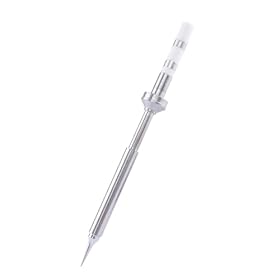
Station that shares a tip family with a portable iron
A soldering station can share tips with a portable iron only when the heater, tip interface, dimensions, and manufacturer compatibility are aligned. Here is how to check before buying.
Station that shares a tip family with a portable iron
A soldering station can share a tip family with a portable iron, but a similar-looking tip is not enough. The station must support the same tip interface and heater design, and the tip must be approved for that station or handpiece. Before buying, compare the exact tip family, compatibility chart, dimensions, and whether the heater is built into the tip or located in the handpiece.
What “same tip family” actually means
Soldering tips are not universally interchangeable. Two tips may have a similar diameter or pointed shape but use different methods to transfer heat.
The most important compatibility details are:
Tip interface: The way the tip slides over, plugs into, or attaches to the handpiece.
Heater location: Some systems place the heating element inside the replaceable tip. Others use a separate heater in the iron and a passive tip around it.
Tip dimensions: Length, internal diameter, shoulder position, and contact area can all matter.
Electrical contacts: Integrated-cartridge tips may use contacts or a connector that a conventional station cannot accept.
Temperature sensing: The station’s control system must work with the sensor arrangement used by the tip or handpiece.
Manufacturer approval: A compatibility chart is more reliable than appearance alone.
A portable iron and a station may use the same general tip shape while still requiring different electrical or mechanical connections. Do not force a tip into a handpiece or assume it is compatible because it fits loosely.
Check the portable iron first
Find the portable iron’s exact model and look for its replacement-tip documentation. The product manual, manufacturer’s tip catalog, or parts page may identify the tip family by a series name, part number, or cartridge designation.
Record these details before shopping for a station:
The exact iron model.
The replacement-tip part number or family name.
Whether the heater is integrated into the tip.
The tip’s approximate length and mounting style.
Any listed operating temperature or power requirements.
Whether the iron is ESD-safe or intended for electronics work.
If the portable iron uses a tip cartridge with an integrated heater, look for a station that explicitly lists that cartridge family. If the portable iron uses a conventional slide-on tip, confirm that the station’s handpiece accepts the same internal diameter and tip length.
Product prices and availability are accurate as of the date/time indicated and are subject to change. Any price and availability information displayed on Amazon.com at the time of purchase will apply to the purchase of this product.
Compare the station’s handpiece, not just the control box
The station’s handpiece determines whether the tip will fit and operate correctly. A station can have suitable temperature controls and adequate power while using an incompatible iron handle.
Check the following:
The handpiece model supplied with the station
The supported tip families
The connector or cartridge interface
The heater and sensor arrangement
Whether replacement handpieces are available
Whether the manufacturer publishes a tip compatibility table
A station advertised as having “interchangeable tips” may still support only one proprietary family. The phrase does not necessarily mean it accepts tips from every portable iron.
Product prices and availability are accurate as of the date/time indicated and are subject to change. Any price and availability information displayed on Amazon.com at the time of purchase will apply to the purchase of this product.
Specifications that affect the buying decision
Tip compatibility documentation
This is the most important specification for your goal. Prefer a station whose documentation names the exact tip family or portable-iron model. If the listing only shows a photograph, contact the manufacturer or seller before ordering.
Power and heat recovery
Station wattage affects how quickly the tip recovers after touching a joint, ground plane, connector, or other heat-absorbing part. A higher published wattage does not automatically mean the iron runs hotter; temperature is controlled separately. It can, however, indicate greater available heating capacity when the design and tip support it.
For small electronics, tip compatibility and stable control usually matter more than choosing the largest power rating. For boards with large copper areas, a station with better heat recovery may be more useful than one with a higher maximum temperature alone.
Temperature range and control
A broad temperature range is less important than predictable regulation at the temperatures you actually use. Confirm that the station supports the manufacturer’s recommended range for the compatible tips and solder type.
Avoid setting the temperature unnecessarily high. Excessive heat can lift PCB pads, damage insulation, burn flux, and shorten tip life.
ESD protection and grounding
For sensitive electronics, look for an ESD-safe iron and follow the manufacturer’s grounding instructions. An ESD-safe label is not a substitute for proper bench grounding, especially when working on static-sensitive components.
Do not modify the station’s ground connection or use an unapproved power adapter to make a portable iron or handpiece work with a station. Electrical changes can create shock, fire, or equipment-damage hazards.
Tip availability
A compatible system is less useful if replacement tips are difficult to find. Check whether the family includes the shapes you need, such as conical, chisel, bevel, or fine-point tips, and whether those tips are available from an established parts source.
Also compare the cost and availability of common working sizes. A station that shares a family with your portable iron may be worthwhile if it lets you keep using tips you already own, but only if those tips are still suitable for the station’s heat and sensing system.
Common compatibility mistakes
Matching by appearance
A pointed tip that looks identical may have different internal dimensions or electrical contacts. Use part numbers and compatibility tables instead of visual matching.
Assuming all cartridge tips are interchangeable
Cartridge systems often combine the tip, heater, and temperature sensor in one assembly. Similar cartridge shapes can use different contact layouts or control requirements.
Ignoring the handpiece model
The station may support multiple handpieces, but the included handpiece may not use the same tip family as your portable iron. Check the complete station configuration rather than the controller alone.
Buying an adapter without documentation
Adapters can change the mechanical connection, but they do not necessarily provide the correct electrical path, heater control, or temperature sensing. Use an adapter only when the manufacturer specifically supports that combination.
Treating tip compatibility as the only reason to upgrade
A station also changes how you work. Consider whether you need a stable stand, adjustable temperature, sleep mode, calibration options, ESD protection, or better heat recovery. If you only need occasional repairs, a compatible portable iron may remain the simpler choice.
A practical buying checklist
Before purchasing, verify all of these points:
The station documentation names the same tip family as the portable iron.
The supplied handpiece—not just an optional accessory—accepts the tips.
The heater and temperature-sensing method are compatible.
The station’s power and temperature control suit your boards and solder.
The station is appropriate for ESD-sensitive electronics if needed.
Replacement tips are available in the shapes and sizes you use.
The manufacturer provides instructions for fitting, cleaning, and replacing tips.
No adapter, wiring change, or modification is required unless explicitly approved.
If one of these points cannot be confirmed, treat the station as unverified rather than assuming compatibility.
When a different station is the better choice
Choose a different station when the manufacturer does not list your portable iron’s tip family, the tip requires integrated electronics that the station cannot support, or replacement tips are difficult to source. It may be cheaper and safer to buy a station with its own well-supported tip system than to adapt an uncertain combination.
If you already have a large supply of portable-iron tips, compare the cost of replacing those tips with the cost of buying a compatible handpiece or station. For occasional work, keeping the portable iron and adding a conventional station may also be more practical than forcing one system to serve both roles.
When compatibility is confirmed, install the tip according to the manufacturer’s instructions, allow it to heat normally, and stop using the equipment if it behaves erratically, fails to regulate temperature, or shows damaged insulation or connectors.
FAQ
Can any soldering station use the same tips as a portable soldering iron?
No. The station and portable iron must share the same mechanical interface, heater design, temperature-sensing method, and approved tip family. Similar appearance alone does not establish compatibility.
How can I confirm that a station uses my portable iron’s tips?
Find the portable iron’s exact model and replacement-tip part number, then compare it with the station manufacturer’s compatibility chart. Check the supplied handpiece as well as the station controller.
Are integrated-heater tips interchangeable between brands?
Usually not unless the manufacturer specifically lists that combination. Integrated-heater tips can differ in electrical contacts, sensor behavior, and control requirements even when their outside shape is similar.
Does higher soldering-station wattage guarantee better performance?
No. Wattage indicates available heating capacity, but tip design, thermal coupling, temperature regulation, and heat recovery also affect performance. Choose a station with confirmed tip compatibility and suitable control for your work.