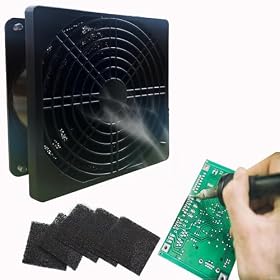
Best Fume Extractor for a Small Bench: What to Look For
For a small soldering bench, the best fume extractor is usually a compact source-capture unit with an adjustable arm, replaceable activated-carbon filtration, and enough airflow to pull smoke away without dominating the workspace.
Best fume extractor for a small bench
For a small soldering bench, choose a compact source-capture fume extractor that can sit beside your work, position its intake close to the solder joint, and use a replaceable activated-carbon filter. A flexible arm is usually more useful than a large room air purifier because it captures smoke at the source before it spreads across the bench.
A fume extractor reduces exposure to soldering flux smoke, but it does not make poor ventilation safe. Keep the room reasonably ventilated, avoid placing your face over the work, and follow the solder, flux, and extractor manufacturers’ instructions.
What works best on a small bench?
The most practical design is a small benchtop unit with:
A flexible or adjustable capture arm
A filter containing activated carbon
A fan with multiple speed settings
A compact footprint that leaves room for the station and tools
A replaceable filter that is easy to find
An intake that can be positioned a few inches from the solder joint
A simple fan with a filter mounted behind the work can help, but it is less effective if the smoke has already crossed your breathing zone. Source capture is the key feature: position the intake near the plume without blocking your view or heating the filter with the soldering iron.
Features that matter most
Source-capture distance and arm adjustment
A fume extractor works best when the intake is close to the smoke source. A flexible arm, articulated arm, or movable hood lets you place the intake near the joint while keeping it out of the way.
Check whether the arm stays where you position it. An arm that droops or slowly moves away from the work can make a compact unit much less useful. A broad intake hood can capture smoke over a wider area, while a narrow nozzle may provide more focused capture but require more precise positioning.
Activated-carbon filtration
Activated carbon is the important filter material for many soldering-flux fumes because it adsorbs some gaseous compounds and odors. Look for a replaceable carbon filter rather than a permanently sealed filter that requires replacing the entire unit.
Filter labels vary, so do not assume that a thicker or darker filter is automatically better. The useful specifications are the filter type, size, replacement availability, and the manufacturer’s recommended replacement interval. A prefilter can also help catch larger particles and extend the life of the carbon stage.
Airflow and speed control
Higher airflow is not always better on a crowded bench. Excessive airflow can disturb lightweight components, pull heat away from the joint, or make the extractor noisy. Adjustable speed lets you use a lower setting for routine soldering and increase it when more smoke is produced.
Manufacturers may describe airflow using different measurements, and published values may not be directly comparable. Treat airflow numbers as a rough guide unless the test conditions are clearly stated. Capture performance at the workpiece and the intake position matters more than a large headline number by itself.
Noise
Noise matters if you solder for long sessions or share the room with other people. A unit with multiple speed settings can be quieter when the soldering job produces little smoke. A compact fan may be more convenient, but its smaller housing can produce a noticeable high-pitched sound at full speed.
If possible, place the extractor on a stable surface and use any supplied rubber feet or vibration-damping pads. Do not cover the ventilation openings to reduce noise; restricted airflow can overheat the fan and reduce capture.
Size and placement
Measure the available space before buying. Leave room for the soldering station, stand, brass wool or sponge, components, and the work itself. The extractor should not force the iron cord into a sharp bend or make it difficult to return the iron safely to its stand.
For a very narrow bench, a rear-mounted or side-mounted arm may be more practical than a unit with a large front housing. If you regularly work on larger boards, prioritize arm reach and positioning range over the smallest possible footprint.
Product prices and availability are accurate as of the date/time indicated and are subject to change. Any price and availability information displayed on Amazon.com at the time of purchase will apply to the purchase of this product.
Fume extractor types for a small workspace
Compact benchtop source-capture units
These are generally the best fit for electronics benches. They combine a small fan, filter, and movable intake in one unit. They are convenient when you cannot install ductwork and need to move the setup between work areas.
Their limitations are limited filter capacity, modest capture area, and fan noise. They also require regular filter replacement to remain useful.
Flexible-arm extraction systems
A flexible-arm system gives more precise positioning and can be easier to keep near the solder joint. It is a strong choice if you work under magnification or need the intake to stay in a particular location.
Check the arm’s reach, stiffness, and mounting method. A clamp-mounted design can save bench space, but it must attach securely to the bench or a suitable support.
Overhead or room air cleaners
A room air cleaner can reduce airborne particles after they disperse, but it is not a substitute for source capture. It may be useful as a supplemental measure in a larger workspace, especially when several people solder or when an extractor cannot be positioned close enough to the work.
For a small bench, an overhead purifier often takes more space and provides less direct control than a compact extractor with an adjustable arm.
Product prices and availability are accurate as of the date/time indicated and are subject to change. Any price and availability information displayed on Amazon.com at the time of purchase will apply to the purchase of this product.
How to choose the right one
Choose a compact benchtop extractor with a flexible arm if you:
Have limited bench space
Solder one board or joint at a time
Need the setup to be portable
Want direct control over intake position
Prefer replaceable filters over disposable whole units
Choose a larger or arm-mounted system if you:
Work on large boards or assemblies
Need the intake to stay fixed for long sessions
Solder frequently or for extended periods
Can dedicate more space to the extraction setup
Before buying, verify the filter replacement cost and availability, not just the initial unit design. A low-cost extractor that has no practical replacement filter may become ineffective or uneconomical to maintain.
Product prices and availability are accurate as of the date/time indicated and are subject to change. Any price and availability information displayed on Amazon.com at the time of purchase will apply to the purchase of this product.
Setup tips for better capture
Put the extractor beside or slightly behind the soldering area.
Position the intake close to the joint, but not so close that it obstructs the iron or pulls on loose parts.
Start with a moderate fan speed and increase it if smoke escapes toward your face.
Keep the intake and filter openings unobstructed.
Replace or clean filters according to the manufacturer’s instructions.
Continue using general room ventilation, especially during long soldering sessions.
Avoid pointing a strong fan directly across the joint. Cross-drafts can carry smoke through your breathing zone and may cool the joint before the solder flows properly.
When to replace the filter or unit
Replace the filter when the manufacturer recommends it, when airflow drops noticeably, or when odors begin passing through despite correct positioning. A clogged prefilter can cause weak airflow, while a spent carbon filter may allow odors to return even though the fan still sounds normal.
A replacement filter is the sensible next step when the fan still runs normally and the housing, arm, and controls are intact. Replace the entire unit when replacement filters are unavailable, the arm can no longer hold position, the fan has become unusually noisy, or the extractor shows electrical damage.
Unplug the unit before inspecting it. Do not open or repair electrical components unless the manufacturer permits it and you are qualified to do so. If a unit smells electrically burnt, becomes unusually hot, sparks, or repeatedly trips a circuit, stop using it and have it assessed or replace it.
Bottom line
The best fume extractor for a small bench is usually not the biggest or most powerful model. Prioritize close source capture, an adjustable arm, activated-carbon filtration, manageable noise, and readily available replacement filters. Good placement and regular filter maintenance often matter as much as the extractor’s advertised airflow.
FAQ
Do I need a fume extractor for occasional soldering?
It is a sensible precaution whenever soldering produces visible flux smoke, even during occasional work. Position the intake close to the joint, maintain reasonable room ventilation, and follow the solder and flux safety instructions.
Is an activated-carbon filter enough for soldering fumes?
Activated carbon is commonly used to reduce odors and some gaseous compounds from flux smoke, but filter performance depends on the material, airflow, and condition of the filter. It does not eliminate the need for ventilation or safe soldering practices.
How close should a fume extractor be to the soldering joint?
Place the intake as close as practical without blocking your view, interfering with the iron, or disturbing components. Source capture becomes less effective as smoke spreads away from the joint.
Can a regular fan replace a soldering fume extractor?
A regular fan may move smoke around rather than capture and filter it. If you use supplemental airflow, avoid directing it across the joint and toward your face; a source-capture extractor with suitable filtration is generally the better choice.
How often should I replace a soldering fume extractor filter?
Follow the manufacturer’s schedule and replace it sooner if airflow drops, odors return, or the filter becomes visibly loaded. Replacement timing varies with soldering frequency, flux type, and the filter design.