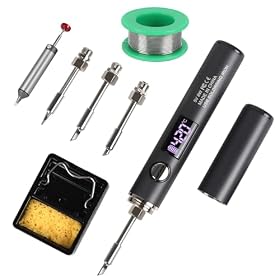
The best portable soldering iron for field repairs depends on how much power, runtime, temperature control, and flexibility you need away from a workbench. This guide compares the main portable designs and explains what to check before buying.
A good portable soldering iron for field repairs should heat quickly, maintain a usable temperature under load, work with the power sources available on site, and pack safely with its tips and accessories. For occasional wire repairs, a battery or USB-C iron may be the most convenient choice. For repeated connector, circuit-board, or heavier wire work, a butane iron or compact temperature-controlled station may provide more sustained heat.
Choose the power type first
Portability is mostly a power-source decision. Each design has different strengths in the field.
Battery-powered soldering irons
Battery irons are convenient when you need a cordless tool that can be ready without a separate power bank or outlet. They are useful for quick repairs, automotive work, hobby electronics, and service calls where setup time matters.
Check:
Whether the battery is built in or replaceable
Charging time and expected working time
Whether the tool can be used while charging
Availability and cost of replacement batteries, if applicable
How the tool indicates low battery or reduced heating performance
Battery models can be less suitable for long repair sessions if the battery is not replaceable or the tool loses heat quickly on larger joints.
USB-C soldering irons
USB-C irons are often the easiest option to transport because they can use a compatible wall charger, power bank, laptop charger, or vehicle adapter. However, the charger and power source must provide the electrical output required by the iron. A basic phone charger may not deliver enough power for reliable heating.
Look for a tool that clearly states its input requirements and use a charger and cable that meet those requirements. A high-output USB-C power bank can be useful, but its capacity, output rating, and automatic shutoff behavior affect runtime.
USB-C models are a strong choice when you already carry suitable charging equipment and need a small iron for light to moderate repairs.
Butane soldering irons
Butane irons avoid electrical cords and do not depend on a charged battery. They can provide strong heat for field repairs, wire work, heat-shrink tubing, and jobs where an outlet is unavailable.
Their tradeoffs include fuel storage, ventilation, flame or hot-gas safety, and less precise temperature control on some designs. Butane tools should be used only as directed by the manufacturer and away from combustible materials. They are generally a poor choice for delicate electronics if the model does not provide a controlled, low-temperature soldering mode.
Compact corded irons or stations
A small corded iron or compact station is not cordless, but it may be the best portable choice when a vehicle inverter, generator, or outlet is available. These tools typically offer more predictable heating and better temperature adjustment than the smallest cordless designs.
If you regularly repair circuit boards or work for extended periods, carrying a compact station may be more practical than relying on a small battery iron with limited runtime.
Features that matter for field repairs
Temperature control
Adjustable temperature is more useful than a simple hot-or-cold switch when you work on different materials. Lower settings can reduce the risk of lifting pads or damaging insulation, while higher settings may be needed for larger connectors, ground planes, or heavier wire.
Choose a tool with a clearly specified temperature range and controls that are easy to operate without accidentally changing the setting. Preset temperatures can be convenient, but they are less flexible than continuous adjustment.
Temperature control does not make a tool safe for every job. The correct setting also depends on the solder, tip size, joint mass, board construction, and manufacturer guidance.
Tip compatibility and availability
A portable iron is only useful if replacement tips are easy to obtain. Before buying, check which tip family it uses and whether the available shapes match your work.
Conical tips: useful for precision work but can transfer heat less effectively on larger joints
Chisel tips: provide a broad contact area and are often more versatile
Bevel tips: useful for dragging solder and transferring solder to a joint
Specialty tips: may help with connector, wire, or desoldering tasks
Avoid choosing a tool solely because it includes many tips. Tip quality, fit, availability, and cost usually matter more than the number included in the box.
Heat-up and recovery
Fast heat-up is helpful when making a quick repair, but heat recovery is more important when soldering a series of joints. A tool that reaches temperature quickly but cannot maintain heat may struggle with larger terminals or ground-connected components.
Manufacturers do not always describe recovery performance in the same way, so consider the tool's intended work, available power, tip design, and user feedback rather than relying on a heat-up number alone.
Size, grip, and controls
A field tool should fit comfortably in the hand and remain stable while you position a wire or component. Look for:
A grip that keeps fingers away from the hot tip and barrel
Controls that are accessible but not easily pressed by accident
A readable temperature or power indicator
A stand, cap, or protective case for the hot tool
A balanced design that does not pull against the joint
Very small irons are easy to carry, but their short handles and small grips may be tiring during repeated repairs.
Charging and accessories
A portable repair kit may need more than the iron itself. Check whether the package includes or supports a suitable charger, cable, stand, protective cap, cleaning sponge or brass wool, and carrying case.
For field work, a case is particularly valuable because it keeps tips, solder, flux, and the hot-tool protection together. Do not place a hot iron in a closed case unless the manufacturer specifically provides a safe method for doing so.
Product prices and availability are accurate as of the date/time indicated and are subject to change. Any price and availability information displayed on Amazon.com at the time of purchase will apply to the purchase of this product.
Match the iron to the repair
Small electronics and circuit boards
Prioritize adjustable temperature, fine but usable tips, stable control, and low heat transfer to surrounding components. A USB-C or battery model can work well for occasional board repairs if it has suitable tips and enough power for the joints involved.
Use flux appropriate for electronics and avoid excessive heat or prolonged contact with pads. For static-sensitive equipment, follow the repair environment's grounding and ESD requirements.
Wires and terminals
Wire repairs often need more heat than tiny signal joints, especially when the wire or terminal draws heat away from the joint. A chisel or bevel tip and a tool with stronger heat recovery may be preferable to an ultra-compact precision iron.
A butane iron or higher-output cordless model can be useful in the field, but protect insulation and nearby materials from excess heat.
Automotive and outdoor service
Choose a tool that can tolerate transport, has a secure cap or case, and works with the power sources available in the vehicle or service kit. Butane can be convenient away from electrical power, while USB-C is useful if your vehicle or battery system can supply the required output.
Keep soldering away from fuel vapors, spilled fluids, and other flammable materials. Disconnect power from the circuit before soldering unless the equipment manufacturer provides a specific service procedure.
Occasional emergency repairs
For infrequent use, simplicity may matter more than maximum output. A compact USB-C iron with a suitable power bank can reduce the number of items you need to carry. If the repair may involve heavy wire, large connectors, or long sessions, choose a tool with more thermal capacity instead of the smallest available design.
Product prices and availability are accurate as of the date/time indicated and are subject to change. Any price and availability information displayed on Amazon.com at the time of purchase will apply to the purchase of this product.
Safety and field-use considerations
Soldering irons remain hot after they are switched off. Use a stable stand or protective cap, keep the hot end away from cables and clothing, and allow the tool to cool before packing it. Provide ventilation or use suitable fume extraction, especially when working indoors or in a vehicle.
Do not solder energized circuits. Disconnect batteries and power supplies where appropriate, and verify that stored energy has been discharged before touching the circuit. For mains-powered equipment, high-voltage systems, lithium battery packs, or safety-critical wiring, follow the manufacturer's service instructions and use a qualified professional when you are not trained for the work.
Product prices and availability are accurate as of the date/time indicated and are subject to change. Any price and availability information displayed on Amazon.com at the time of purchase will apply to the purchase of this product.
What to check before buying
Use this short checklist:
Power source: Can you reliably charge, fuel, or power the iron where repairs happen?
Repair size: Is it intended for fine electronics, wires, connectors, or a mixture?
Temperature control: Can you set an appropriate temperature instead of relying on one fixed output?
Tip supply: Are compatible replacement tips available in useful shapes?
Runtime: Can it handle your typical repair session without an inconvenient recharge or refill?
Heat recovery: Will it maintain heat on the largest joints you expect to solder?
Safe storage: Does it include a stand, cap, or case suitable for transport?
Consumables: Can you easily carry the correct solder, flux, tip cleaner, and spare power accessories?
Product prices and availability are accurate as of the date/time indicated and are subject to change. Any price and availability information displayed on Amazon.com at the time of purchase will apply to the purchase of this product.
When a portable iron is not the right tool
A portable iron is a poor substitute for a full station when you perform frequent bench work, need precise repeatable temperature control, solder large ground planes, or repair many joints continuously. In those cases, use a proper temperature-controlled station and keep the portable iron for service calls and quick repairs.
If a cordless iron no longer reaches temperature, shuts down early, or has damaged charging hardware, inspect the tip, power source, and consumables first. If the battery is degraded or the heating element and control electronics have failed, replacement is usually more sensible than attempting an improvised repair. Do not bypass thermal protection or modify the charging circuit.
FAQ
What is the best power source for a portable soldering iron?
There is no single best option. USB-C is convenient when you already carry a suitable high-output charger or power bank, battery models are simple and cordless, and butane models avoid electrical charging while providing useful heat for heavier field repairs.
Are portable soldering irons good for circuit boards?
They can be, provided the iron offers suitable temperature control, compatible fine or medium tips, stable heat, and enough precision for the board. Use an appropriate electronics solder and flux, and follow ESD precautions when required.
How much power should a USB-C soldering iron use?
Use the input requirements stated by the manufacturer. The charger, power bank, and cable must all support the required output; a low-output phone charger may cause slow heating or unreliable temperature maintenance.
Should I choose a butane soldering iron for automotive repairs?
A butane iron can be useful for wire and terminal repairs when electrical power is unavailable, but it requires careful ventilation and flame or hot-gas precautions. Keep it away from fuel vapors and other combustible materials, and use a controlled electrical iron when working near sensitive electronics.
How should I store a portable soldering iron after use?
Switch it off, place it in its stand or protective holder, and wait until the tip and barrel are cool before packing it. Follow the manufacturer's instructions for fuel storage, battery charging, and protective caps.