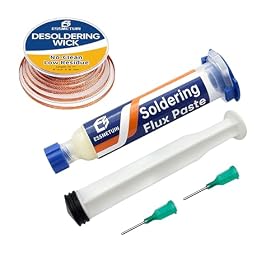
You can reduce solder smoke in winter without a dedicated extractor by controlling the flux, positioning a fan to move fumes away from your breathing zone, and ventilating without creating an unsafe draft. These measures are temporary substitutes—not a complete replacement for source capture.
Solder smoke indoors during winter is usually flux vapor and particulates released when the soldering iron heats flux—not smoke from the metal itself. If you do not have a fume extractor, work in a ventilated area, keep your face out of the plume, use only the flux you need, and move contaminated air away from you rather than blowing it around the room. Because winter ventilation can be uncomfortable, short work sessions and a properly positioned exhaust fan are usually safer than soldering in a sealed room.
Reduce the smoke at the source
Use less flux
Excess flux creates more visible fumes. Apply a small amount to the joint or use solder with a flux core suited to the work. Avoid repeatedly flooding a connection with liquid flux unless the product instructions call for it.
Do not assume that lead-free solder is fume-free. The solder alloy and flux are separate concerns, and heated flux can still produce irritating fumes.
Keep the iron at the correct temperature
An unnecessarily hot tip can burn flux faster and create more smoke. Set the iron according to the solder and flux manufacturer's guidance, then use the lowest temperature that allows the joint to form properly. A clean, properly tinned tip also transfers heat more effectively than a dirty or oxidized one.
Avoid unnecessary rework
Plan the joint, secure the parts, and keep the tip on the connection only as long as needed. Reheating a joint repeatedly increases the amount of flux vapor released.
Ventilate without making the room dangerously cold
A fully open window may be uncomfortable in winter, but you do not need to leave it open for hours. Instead, consider short ventilation periods during and after soldering:
Open a window slightly, if practical.
Place a fan so it moves air from behind or beside you toward the window—not from the workbench directly into your face.
Keep the soldering area close to the exhaust path while avoiding drafts that disturb small components or cool the joint.
Ventilate for a while after finishing, especially if you used liquid flux or soldered for an extended period.
Do not exhaust air near a furnace, boiler, dryer, or other combustion-air intake. Do not block a required HVAC vent, and do not use a setup that creates a risk of carbon monoxide or other combustion products being drawn indoors. If you are unsure whether a window-fan arrangement is safe in your space, consult a qualified HVAC professional.
Product prices and availability are accurate as of the date/time indicated and are subject to change. Any price and availability information displayed on Amazon.com at the time of purchase will apply to the purchase of this product.
Keep the fume plume away from your breathing zone
Solder with your head to the side of the joint rather than directly above it. The visible plume rises, so leaning over the workbench places your face in its path. A small fan can help, but a fan blowing across the joint may spread fumes through the room instead of removing them.
A temporary arrangement should move air away from your face and, ideally, out of the room. A fan that only recirculates air is not equivalent to source capture. It may reduce the visible plume in front of you while distributing contaminants elsewhere.
Product prices and availability are accurate as of the date/time indicated and are subject to change. Any price and availability information displayed on Amazon.com at the time of purchase will apply to the purchase of this product.
Improve the setup for winter work
Work near an exterior window
A bench near a window makes temporary exhaust easier. Keep cords away from the window, heater, and walkways, and make sure the fan cannot pull the soldering iron or loose materials off the bench.
Use short sessions
For a small repair, work in brief sessions, turn off and secure the iron, leave the area to ventilate, and return only when the air is clear. This is more practical than keeping a window wide open throughout a long project.
Avoid enclosed spaces
Do not solder inside a vehicle, closet, cabinet, or other poorly ventilated enclosure. Winter cold does not make an enclosed room safer. If ventilation is inadequate, postpone the work or move it to a better location.
Do not rely on a household air purifier alone
A purifier with a particle filter may capture some airborne particles, but it is usually not positioned close enough to the soldering joint to replace source extraction. Activated carbon can help with some gases and odors, but its performance depends on the amount and type of carbon, airflow, and the contaminant. An ordinary room purifier should be treated as supplemental, not as permission to solder in a sealed room.
Product prices and availability are accurate as of the date/time indicated and are subject to change. Any price and availability information displayed on Amazon.com at the time of purchase will apply to the purchase of this product.
When a fume extractor is the better solution
If you solder regularly, work for long periods, or cannot ventilate outdoors, a fume extractor is the more reliable winter setup. Look for a unit designed for soldering and place its intake close to the joint without obstructing your work.
Important specifications include:
Capture position: An arm or nozzle that can stay close to the joint is more useful than high airflow from across the room.
Filter type: Particle filtration and activated carbon address different parts of the fume problem. Check the manufacturer's stated filter arrangement and replacement schedule.
Replacement filters: Confirm that replacement filters are available before buying.
Noise and footprint: A quieter, compact unit is more likely to remain correctly positioned on a small bench.
Exhaust design: A unit that recirculates filtered air is different from one that ducts air outdoors. Follow the manufacturer's installation instructions.
Do not place your face between the joint and the extractor intake. Keep the intake close enough to capture the plume, but not so close that it interferes with the tip, parts, or safe handling of the iron.
Basic safety precautions
Wear safety glasses when soldering.
Wash your hands after handling solder, flux, or contaminated tools, especially before eating.
Keep food and drinks away from the bench.
Use a stable iron stand and turn the iron off when it is unattended.
Follow the solder and flux safety data sheets for ventilation and handling guidance.
Stop if you experience eye, throat, or breathing irritation and move to fresh air.
If soldering causes persistent symptoms, or if you are working with unusual fluxes, coatings, plastics, or other heated materials, stop work and seek appropriate medical or workplace-safety advice.
Bottom line
For occasional winter soldering, use minimal flux, keep your head out of the plume, and create a controlled airflow toward an exterior opening. A recirculating fan or household purifier is only a partial measure. If you solder often or cannot ventilate safely, buy a soldering fume extractor or change locations rather than relying on an improvised sealed-room setup.
FAQ
Is solder smoke dangerous if I only solder occasionally?
Occasional brief exposure is still best minimized. Soldering fumes commonly come from heated flux and can irritate the eyes, throat, and airways. Use ventilation, keep your face out of the plume, and follow the solder and flux manufacturer's safety instructions.
Can I use a regular fan instead of a soldering fume extractor?
A regular fan can move fumes away from your breathing zone, but it may spread them around the room. It is more useful when arranged to exhaust air outdoors and positioned so it does not blow directly across the joint or into your face.
Does lead-free solder produce less smoke?
Not necessarily. Visible fumes are primarily associated with heated flux, while the solder alloy determines other handling risks. Lead-free solder does not eliminate the need for ventilation.
Should I open a window when soldering in winter?
A slightly open window with controlled exhaust can be a reasonable temporary solution for short jobs. Avoid drafts that blow fumes toward you, keep electrical equipment dry and stable, and do not exhaust air near combustion-air intakes.
Is an air purifier enough for soldering?
Usually not by itself. A room purifier may provide supplemental filtration, but it is not source capture. A soldering fume extractor positioned near the joint, or ventilation that removes air outdoors, is generally more appropriate.