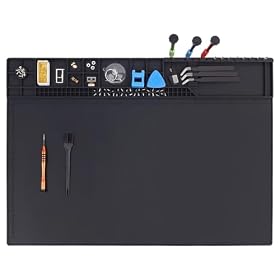
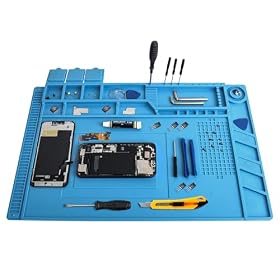
A silicone mat is a useful first purchase for electronics work, but the right one depends on your workspace, project size, and safety needs. Here is what to check before buying.
A silicone mat is one of the most useful accessories to buy before your first soldering kit. It protects the work surface from brief contact with a hot soldering iron, catches solder splashes, keeps small parts from rolling away, and makes cleanup easier. Choose based on mat size, heat rating, layout, and whether you need ESD protection—not simply the thickest or largest mat available.
Do you need a silicone soldering mat?
You can solder without one, but an ordinary table, plastic surface, or unfinished wood desktop is a poor substitute. A dedicated mat provides a defined work area and adds protection against hot tools, solder, flux, and minor scratches.
A mat does not make soldering fireproof. Do not leave a hot iron unattended, place the iron tip directly on the mat, or assume the mat will protect against prolonged contact with a heater or open flame. Use the iron’s stand and follow the instructions for both the iron and the mat.
A silicone mat is especially useful if you:
Solder at a desk or kitchen table that needs protection
Work with small electronic components
Want molded trays for screws, connectors, and parts
Frequently use flux or solder that can leave residue
Need a surface that wipes clean more easily than wood or fabric
What to look for before buying
Size and usable workspace
Measure the area where you actually solder, not just the available desk. A mat should leave enough room for the circuit board, soldering station, tools, and a safe place for the iron stand.
Small mats are easier to store and may be sufficient for occasional repairs. Larger mats are more comfortable for kits, wiring, and several tools, but they need a stable, flat surface. Check the listed dimensions and remember that molded compartments may reduce the flat working area.
If you use a separate soldering station, make sure the mat can accommodate the station’s control unit or leave room beside it. The hot iron and stand should never be positioned where the cord can pull them across the work area.
Heat rating and heat behavior
Check the manufacturer’s stated temperature and use limits. These specifications are not interchangeable: a mat may tolerate brief contact with a hot object without being intended for prolonged direct heat.
The mat should support normal soldering work, but the iron belongs in its stand. Do not use the mat as a replacement for a metal soldering stand, and do not place a hot tip directly on silicone unless the manufacturer specifically permits that use.
A thicker mat may provide more protection from brief heat and help it stay flat, but thickness alone does not establish a safe temperature rating. Prefer clear manufacturer information over vague claims such as “high temperature” or “heatproof.”
Material and surface quality
Look for a silicone mat marketed specifically for soldering, electronics repair, or heat-resistant bench work. It should lie flat, resist sliding, and have a surface that does not shed fibers or leave an oily residue.
New silicone products can have an odor. Allow the mat to air out in a well-ventilated area before use if necessary. Keep it away from sharp blades, aggressive solvents, and prolonged contact with chemicals unless the manufacturer lists them as compatible.
Compartments and molded organizers
Built-in trays can be valuable for screws, jumpers, components, and connectors. They are most useful when they are deep enough to keep parts separated and easy to reach.
Organizers are less important if you already use small parts bins. Raised sections can also make it harder to slide a large circuit board or project enclosure across the mat. Treat compartments as a convenience feature, not a substitute for a well-organized bench.
ESD protection
Standard silicone is not automatically an antistatic or ESD-safe work surface. If you will handle sensitive integrated circuits, microcontrollers, memory, or other static-sensitive parts, look for a product with a stated ESD or antistatic specification and follow the manufacturer’s grounding instructions.
An ESD mat may need a grounding cord and a suitable ground point. Do not improvise a connection to household wiring. If you are unsure how to set up ESD protection safely, follow the station or mat manufacturer’s instructions or ask a qualified technician.
A regular heat-resistant mat can still protect your desk, but it should not be represented as ESD protection when the product documentation does not say that it is.
Product prices and availability are accurate as of the date/time indicated and are subject to change. Any price and availability information displayed on Amazon.com at the time of purchase will apply to the purchase of this product.
What a first soldering setup still needs
A silicone mat protects the bench, but it does not replace the essential parts of a soldering setup. A practical first kit usually needs:
A temperature-controlled soldering iron or soldering station
A stable iron stand with a brass-wool or damp-sponge cleaning option as specified by the iron maker
Suitable solder for the electronics work
Flux when needed
Eye protection
Ventilation or a fume extractor positioned to pull smoke away from your breathing zone
Side cutters and a way to hold the work securely
Keep the mat, iron stand, and project positioned so the iron’s cable does not cross your hand or the edge of the desk. A mat cannot prevent burns caused by poor tool placement.
Product prices and availability are accurate as of the date/time indicated and are subject to change. Any price and availability information displayed on Amazon.com at the time of purchase will apply to the purchase of this product.
Cleaning and maintenance
Let solder residue cool before removing it. For ordinary flux marks, use the cleaning method recommended by the mat manufacturer. A mild cleaner and a soft cloth may be appropriate, but avoid assuming that every solvent is safe for silicone.
Inspect the mat periodically for cuts, melted areas, embedded metal fragments, or sections that have become brittle. Replace it if damage creates an uneven surface, exposes the desk to heat, or makes the mat difficult to clean.
Do not fold a thick mat sharply if that can create permanent creases. Store it flat or roll it only as directed by the manufacturer.
Product prices and availability are accurate as of the date/time indicated and are subject to change. Any price and availability information displayed on Amazon.com at the time of purchase will apply to the purchase of this product.
Common buying mistakes
Buying the smallest mat available
A small mat can leave no safe space for the iron stand or parts. Compare the flat working area—not only the outside dimensions—with your normal project size.
Treating “heat resistant” as “fireproof”
Heat resistance generally describes a specified type or duration of exposure. It does not make the mat suitable for an unattended iron, open flame, or prolonged direct heat.
Assuming every silicone mat is ESD-safe
If static control matters, verify the product documentation and grounding requirements. A generic silicone mat is not automatically suitable for ESD-sensitive electronics.
Choosing compartments over a stable surface
A mat with many molded sections may look convenient but leave too little room for the circuit board. Prioritize a flat, non-sliding work area, then add organizers if needed.
Ignoring ventilation
A mat protects the bench, not your lungs. Soldering fumes and flux smoke should be kept away from your face with suitable ventilation or fume extraction. Follow the guidance for the solder and flux you use.
Product prices and availability are accurate as of the date/time indicated and are subject to change. Any price and availability information displayed on Amazon.com at the time of purchase will apply to the purchase of this product.
Bottom line
Buy a silicone soldering mat before your first kit if you want to protect the work surface and keep small parts organized. For most beginners, the important choices are a large enough flat area, a clearly stated heat rating, a non-slip design, and easy cleaning. Add ESD capability only when your components and work process require it, and continue to use a proper iron stand and ventilation.
FAQ
Can I solder directly on a silicone mat?
A soldering mat is designed to protect the work surface during normal soldering, but the hot iron should remain in its stand. Do not place the tip directly on the mat unless the manufacturer specifically says that use is acceptable.
Are silicone soldering mats ESD-safe?
Not automatically. Look for an explicit ESD or antistatic specification and follow the product’s grounding instructions if you work with static-sensitive components.
What size silicone soldering mat should a beginner buy?
Choose a mat that fits the project, circuit board, tools, and iron stand with room to work safely. Measure your desk and compare the listed flat working area, not only the mat’s total outside dimensions.
How do you clean a silicone soldering mat?
Allow residue to cool, then use the cleaning method recommended by the manufacturer. A soft cloth and mild cleaner may work for some mats, but check chemical compatibility before using solvents.